


Concrete pool vs liner pool: differences, pool lighting and the right niche selection
When choosing a swimming pool, material and finishing play a major role. The choice between a concrete pool and a liner pool not only determines the construction, but also the technology, maintenance and long-term flexibility. These differences are especially important to understand in advance when it comes to pool lighting.
Concrete pool: features, advantages and disadvantages
This type of pool is usually cast or built on-site (structural construction). The finish can consist of tiles, mosaic or a special concrete coating. It is fully customizable and highly robust.
Advantages of a concrete pool
Fully customizable (shape, depth, finish)
Very long lifespan
Luxurious appearance (often with tiles or coating)
Suitable for large-scale use
Disadvantages of a concrete pool
Higher cost
Longer construction time
More complex installation of components such as lighting
Liner pool: features, advantages and disadvantages
This is often also a structural construction (concrete/blocks), but the waterproof layer consists of a PVC liner or reinforced liner applied over the walls and floor. Reinforced liner (1.5 mm or thicker) is heat-welded on-site for a clean and watertight result.
Advantages of a liner pool
Faster installation
More affordable than concrete
Easier maintenance
Widely used in residential pools
Disadvantages of a liner pool
Less flexible in shape
Liner needs replacement after ±10–15 years
More sensitive to damage
Difference between concrete and liner pools
The main difference between a concrete pool and a liner pool lies in construction, durability, maintenance and cost. A concrete pool is a robust, custom-built and long-term investment, while a liner pool is more flexible and easier to maintain.
Concrete lasts longer, while a liner pool requires the liner to be replaced after approximately 10 to 15 years to restore the pool to like-new condition.
Which niche fits which pool?
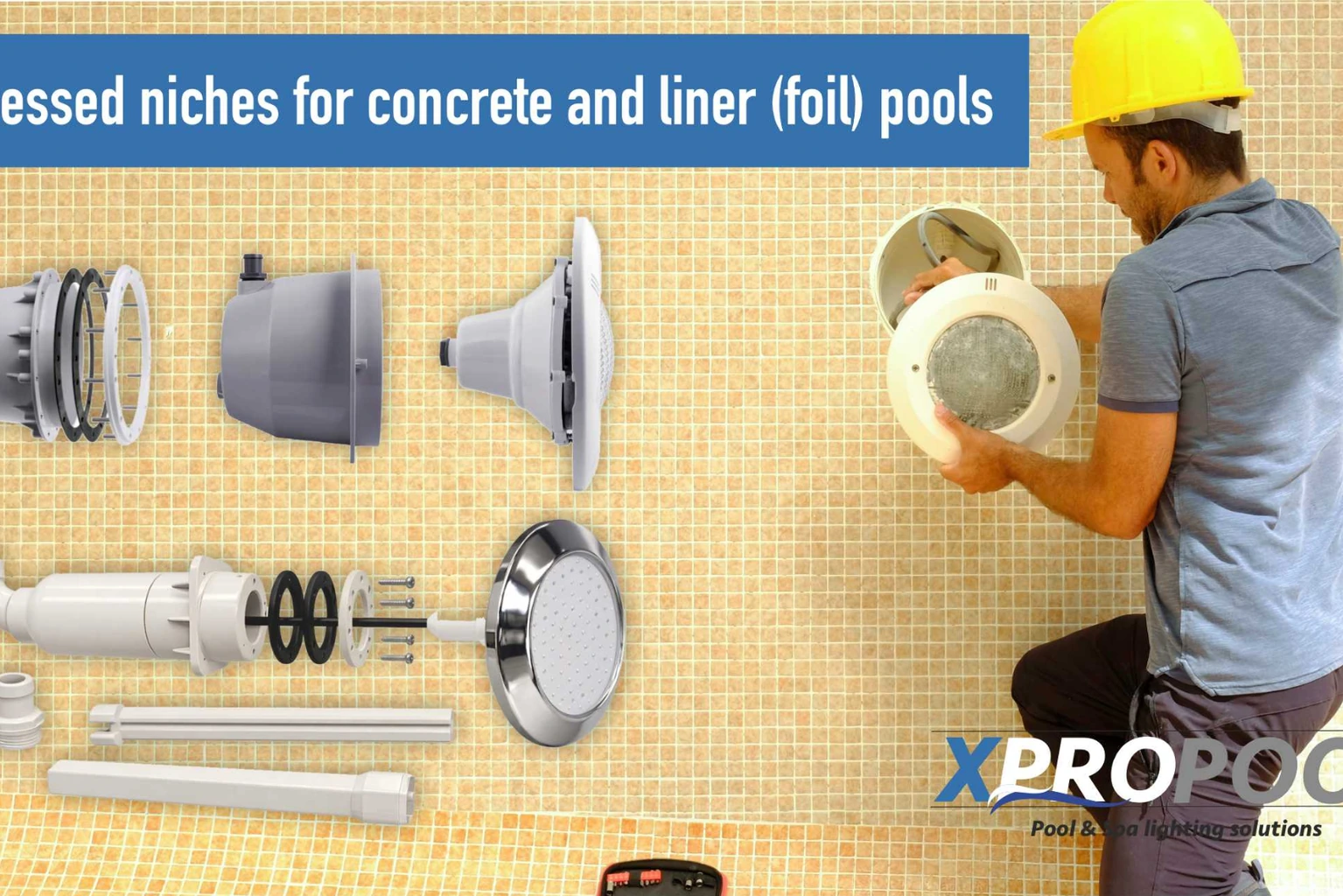
When choosing pool lighting, it is important to select the correct niche. Not every niche is suitable for every type of pool, as the construction of concrete and liner pools differs significantly.
PAR56 niche for concrete pools (XPW-1250 + XPW-1252)
Installation: Cast into the wall during construction — permanent part of the structure
Waterproofing: Provided by the concrete itself, no additional sealing required
Components: Simple construction focused on strength
Flexibility: Permanent — not easily adjustable after installation
Ideal for: New builds and professional projects
PAR56 niche for liner pools (XPW-1251 + XPW-1253)
Installation: Installed in the wall, liner is mounted over it
Waterproofing: Through liner with clamping ring and sealing system
Components: Includes clamping ring, gaskets and screw connections
Flexibility: Suitable for renovation and replacement
Ideal for: Liner pools and adjustable installations
Ø290 niches are available with rings in 3 different colors.
Always check whether a niche is designed for a concrete or liner pool. A concrete niche does not include the rubber seals required to make a liner pool installation watertight, which can lead to leaks.
Nicheless pool lighting: the modern solution
The nicheless fitting (XPW-1200) is specially developed for modern pool lighting. This compact wall fitting ensures a safe and watertight connection without the need for a large niche.
Suitable for both concrete and liner pools.
How does a nicheless fitting work?
The wall fitting is installed in the pool wall
The cable runs through to the technical room
The lamp is screwed directly into the 1.5 inch thread
The connection is immediately watertight and secure
Advantages of nicheless fittings
Standard 1.5 inch connection (global standard)
No large niche required
Fast installation
Easy replacement without demolition work
User-friendly installation
Required installation components
Wall fitting (1.5 inch female thread)
Rubber seals / gaskets
Clamping ring (for liner pools)
Cable gland / connection cable
Optional wall fitting (50–63 mm connection)
Which pool lights are suitable for these systems?
When choosing the right pool light, it is important to know which system you are using. Within XPRO POOL, there are two main types: PAR56 lamps and nicheless pool lights.
PAR56 pool lights (for niches)
Fits Ø280 and Ø290 niches
Available in 12V and 230V
Power: 25W, 35W, 45W and 50W
Warm white, RGB and RGBW
Ideal for large pools and projects requiring high light output.
Nicheless pool lights (1.5 inch)
Direct installation into 1.5 inch thread
Compact design
Power: 18W, 25W, 35W and 45W
Warm white and RGB+W
Made from stainless steel (RVS 316) and fully IP68 waterproof.
Easy to install and replace.
Difference in application
PAR56 lights → traditional niche systems
Nicheless lights → compact wall fitting systems
PAR56 is mainly used for larger pools.
Nicheless is ideal for modern pools and renovations.
Complete systems
XPRO POOL offers complete solutions such as:
RGB+W systems
Nicheless sets
Smart lighting with app control
All components are matched for easy installation.
The right choice for your pool lighting
The choice between a concrete pool and a liner pool has a major impact on the installation of pool lighting. Concrete requires a fixed and permanent solution, while liner pools and nicheless systems offer more flexibility.
By making the right choices in niches and pool lights in advance, you prevent problems and ensure the best possible result.
A well-designed lighting plan, combined with the right components, makes the difference between a standard pool and a professionally illuminated pool.